
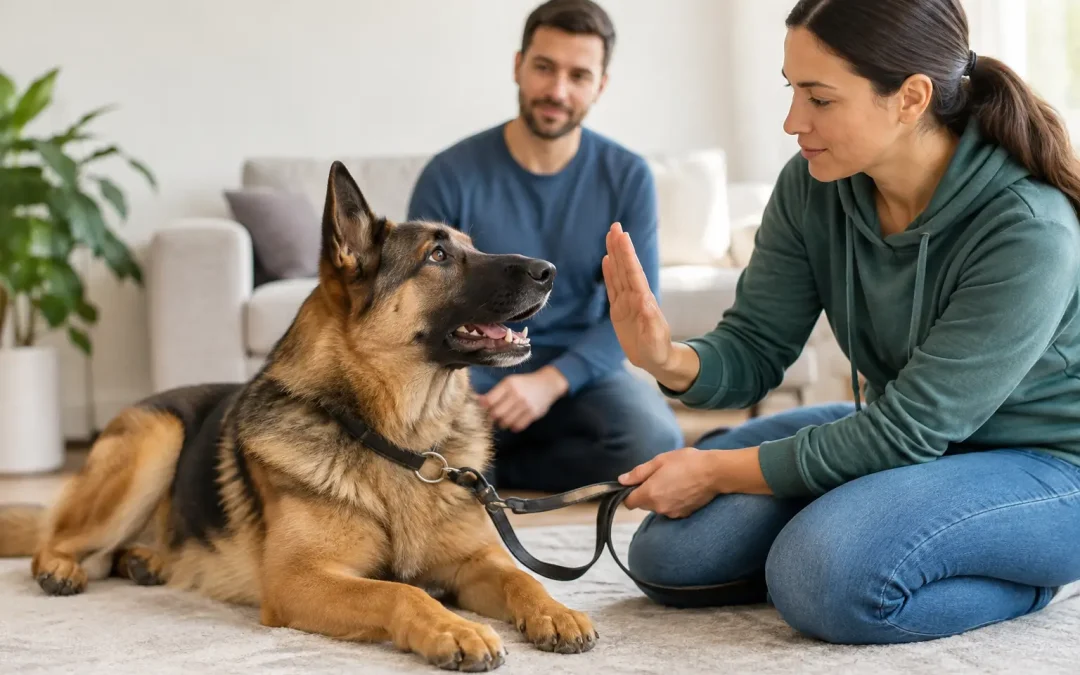
A dog who stiffens at the front door, growls when approached, or reacts suddenly on a walk is not giving a family a simple obedience problem. Aggressive dog rehab addresses a serious safety and relationship concern with structure, skilled observation, and a plan that respects both the dog’s emotional state and the household’s need for control.
Aggression can make everyday life feel smaller. Families may stop inviting people over, avoid certain rooms, change walking times, or keep children and visitors at a distance. Those precautions may be necessary in the moment, but they should not be the only plan. With appropriate professional guidance, many dogs can learn safer responses, clearer boundaries, and more dependable behavior in the situations that once overwhelmed them.
What Aggression Is Communicating
Aggression is a behavior, not a personality label. A dog may bark, lunge, snap, bite, freeze, guard possessions, or use a hard stare because he is frightened, frustrated, overstimulated, protecting space, defending something valuable, or trying to make an uncomfortable interaction stop.
The outward behavior can look similar while the cause is very different. A dog who reacts to strangers entering the home may be worried about unfamiliar people in his space. A dog who growls near a food bowl may be guarding a resource. Another dog may react after repeated excitement, lack of rest, inconsistent handling, or physical discomfort. Effective rehabilitation begins by identifying the pattern instead of treating every display of aggression as the same problem.
This is why a dog should not be punished simply for growling. A growl is a warning signal. If that warning is suppressed without resolving the pressure behind it, a dog may skip the warning next time. The goal is not to create a silent dog. The goal is to create a dog who can remain calm, responsive, and safely managed when a challenge appears.
Aggressive Dog Rehab Starts With Safety
Before behavior changes, the household needs a realistic safety plan. This may include managing access to doors, separating the dog from visitors, using barriers, changing walk routes, and avoiding situations known to produce a reaction. A properly introduced basket muzzle can also be an important safety tool for certain cases. It allows the dog to pant and take treats while reducing bite risk during carefully supervised training.
Management is not a failure or a permanent sentence. It prevents rehearsals of dangerous behavior while new habits are being built. Every time a dog rushes the door, corners a visitor, or successfully drives another dog away, that reaction can become more practiced. Reducing those opportunities gives training room to work.
If a bite has occurred, if a dog has caused injury, or if behavior is escalating, the situation calls for prompt professional assessment. Families should also speak with their veterinarian when pain, illness, sensory changes, or sudden shifts in behavior may be involved. A dog with an untreated medical problem cannot be expected to feel or respond normally.
Why the Home Environment Matters
A dog can perform beautifully in a controlled training setting and still struggle in the hallway, kitchen, driveway, or living room where reactions usually happen. That is why in-home behavior work is especially valuable for aggressive behavior. The trainer can see the actual layout, family routines, doorways, triggers, and handling patterns shaping the dog’s day.
Rehabilitation often begins with the ordinary moments people overlook: how the dog is greeted in the morning, who controls access to furniture or windows, what happens when the doorbell rings, how walks begin, and whether the dog has a predictable place to settle. Clear routines reduce uncertainty. For many reactive dogs, uncertainty is fuel.
At Ramella’s Canine Academy, behavior modification is approached as a relationship-centered process. The dog needs compassion, but compassion does not mean lowering expectations. Families learn to communicate clearly, maintain calm leadership, and follow through consistently so their dog is not left to make high-stakes decisions alone.
Building Control Before Testing Triggers
A dog in a highly aroused state cannot reliably make good choices. For that reason, rehabilitation usually starts by strengthening foundational skills away from the hardest trigger. A dependable response to name, leash guidance, place commands, recall, waiting at thresholds, and settling on cue gives owners practical ways to direct their dog before tension rises.
These skills are not party tricks. They create a shared language. When a delivery person approaches, an owner may need the dog to move to a designated area and remain there. When another dog appears on a sidewalk, the owner may need to turn, create distance, and guide the dog through a familiar command. When family activity becomes chaotic, the dog may need a quiet, structured place to decompress.
The order matters. Asking a dog to tolerate a difficult trigger before he has learned calm, responsive behavior is unfair and can increase risk. Strong obedience gives rehabilitation a framework, while appropriate exercise and rest help the dog arrive at training with a more regulated mind.
Changing the Emotional Pattern
Once the dog has clearer handling and the family has safety procedures in place, training can address triggers in a controlled way. This is often done gradually, at a distance or intensity the dog can handle without exploding into a reaction. The dog learns that he can notice a person, sound, dog, or movement and then look to his owner for direction rather than taking control of the situation.
Progress is rarely a straight line. A dog may improve around calm adults but struggle with fast-moving children. He may handle a person outside yet react when that person enters the house. Weather, fatigue, pain, routine changes, and the distance from a trigger can all affect behavior. Good rehabilitation adjusts to the dog in front of you rather than forcing a fixed timeline.
This work requires careful timing. The handler must recognize early signs of stress, such as body stiffness, closed mouth, fixed eyes, pacing, avoidance, raised hackles, or a sudden inability to respond to familiar commands. Intervening early is safer and more effective than waiting for barking, lunging, or snapping.
The Family’s Role in Lasting Change
Dogs do not experience training as a once-a-week appointment. They experience the rules and responses that happen every day. Everyone involved in the dog’s care needs to understand the plan, especially in homes with children, frequent visitors, or multiple adults with different habits.
Consistency does not require harshness. It means the dog receives the same calm message from the people around him. If jumping at guests, rushing doors, pulling toward triggers, or claiming furniture is allowed sometimes and corrected other times, the dog receives confusing information. Predictable boundaries help a dog relax because the environment becomes easier to understand.
Children should never be expected to manage an aggressive dog or interpret warning signs on their own. Adult supervision, physical separation when needed, and clear household rules protect both children and the dog. A family’s goal is not to prove that a dog can tolerate more than he is ready for. The goal is to create safe, respectful interactions that can be repeated confidently.
What Success Can Look Like
Success in aggressive dog rehab is not always a dog who loves every visitor, dog, or unfamiliar environment. For some dogs, the best outcome is the ability to remain neutral, follow direction, and recover quickly from stress. For others, it may mean peaceful walks at a comfortable distance, safe visitor routines, or a home where the dog can settle instead of constantly monitoring every sound.
That standard is both honest and hopeful. A dog does not need to become socially outgoing to have a good life. He needs a family that understands him, a routine that supports him, and trained responses that keep everyone safe.
The most meaningful change often begins when an owner stops asking, “Why is my dog doing this to me?” and starts asking, “What does my dog need from me to feel safe and follow my lead?” With patient structure, professional direction, and steady expectations, that question can become the beginning of a calmer life together.